
- MSP lead generation is hard because most prospects already have a provider. You win on timing and trust, not on features.
- Target the person who feels the pain: owners and operations leaders at smaller firms, IT and finance leaders at larger ones.
- Watch for triggers such as new offices, fast hiring, compliance or cyber insurance requirements, and leadership changes.
- Referrals and partners convert well but cannot be scaled on demand. LinkedIn outreach adds a steady, controllable source of meetings.
- Lead with a small, low risk first step, such as a security or IT review, rather than a full managed services pitch.
Managed service providers sell something every business needs and almost nobody wants to think about. That is the core challenge of MSP lead generation. Most of your prospects already have an IT provider, an in house person or a nephew who "does the computers", and switching feels risky. This guide covers who to target, when they are most likely to change, which channels work, and how to start conversations that turn into attended sales calls.
Why lead generation is hard for MSPs
Three things make IT services harder to sell than most B2B offers:
- An incumbent is usually in place. You are asking a business to switch, not to buy something new.
- Trust is the product. You will have access to their systems and data, so buyers want proof before they take a meeting.
- Pain is invisible until it is urgent. Many businesses only look for a new provider after an outage, a security incident or a failed audit.
The practical answer is to stay visible to the right companies, and to reach them when something changes. That means precise targeting and a consistent, polite presence, not a one off blast.
Who to target
The right contact depends on company size. As a starting point:
- 10 to 50 employees: the owner, founder or managing director. They often handle IT decisions themselves and feel the pain of downtime directly.
- 50 to 250 employees: the operations director, finance director or office manager who owns the IT contract, plus any internal IT manager.
- 250 employees and above: the IT director, head of IT or CIO, with the CFO involved in contract decisions.
Focus on two or three industries where you already have references, such as professional services, healthcare, manufacturing, construction or financial services. Specialists win more often than generalists because they can speak the buyer's language from the first message.
Buying triggers that open the door
Timing does most of the work in MSP sales. These signals often mean a business is open to a conversation:
- Opening a new office or moving premises.
- Hiring quickly, or posting jobs for IT roles.
- New compliance or client security requirements, such as questionnaires from larger customers.
- Cyber insurance renewals that ask for controls the business does not have.
- A new CEO, COO or finance director, who often reviews existing suppliers.
- A merger, acquisition or new funding round.
- Moving systems to the cloud or replacing old hardware.
Many of these are visible on LinkedIn through job changes, company posts and hiring activity, which is one reason LinkedIn works well for MSP prospecting.
Lead generation channels for MSPs
Most successful MSPs combine a few channels. Referrals and partners bring the warmest leads, while outbound gives you control over volume and timing.
| Channel | Strengths | Limits |
|---|---|---|
| Referrals | High trust and high close rates | Unpredictable volume, hard to scale on demand |
| Vendor and partner programmes | Warm introductions and shared marketing | Shared with other partners, slow to start |
| SEO and content | Compounding inbound demand over time | Takes months, local competition is heavy |
| Events and local networking | Face to face trust | Time heavy, limited reach |
| Cold calling | Direct and fast feedback | Gatekeepers, low connect rates |
| LinkedIn outreach with SDRs | Precise targeting of decision makers, steady meeting flow | Needs good lists, messaging and fast replies |
How to use LinkedIn to book MSP sales calls
LinkedIn lets you filter by job title, company size, industry and location, so you can build a list of exactly the decision makers you want. A simple process looks like this:
- 1Build a list. In Sales Navigator, filter by title, headcount, industry and region, and remove existing clients.
- 2Connect with a relevant note. Mention their industry or location rather than your services.
- 3Follow up with value. Share one practical point about a risk or requirement businesses like theirs face.
- 4Offer a small first step. A short IT or security review is easier to say yes to than a full proposal.
- 5Qualify and book. Ask about headcount, current setup and contract timing, then agree a time.
Example messages you can adapt:
- Connection request: "Hi [First name], I work with accounting firms in the Dallas area on IT and security. Would be good to connect."
- First follow up: "Thanks for connecting. A lot of firms your size are being asked for new security controls at insurance renewal. Is that something you have had to deal with at [Company]?"
- The ask: "If useful, we could do a 20 minute review of your current setup and highlight any gaps, with no obligation to change providers. Would next Tuesday or Wednesday work?"
Notice what the messages do not do. They do not attack the current provider, list services or ask for a long meeting. They make it easy to have a first conversation.
What to say on the first call
The first call should feel like a review, not a pitch. Ask how IT is handled today, what has gone wrong in the last year, what the business is planning, and when the current contract renews. Close by agreeing a clear next step, such as a written assessment. If the timing is wrong, ask when it would make sense to talk again and note it.
Qualifying MSP leads
Not every interested reply should become a call. Agree your criteria before outreach starts, for example:
- Headcount within your target range.
- An industry you serve well.
- A decision maker or someone who will bring them in.
- A contract renewal, project or trigger in the next six to twelve months.
The cost of a meeting, in context
Managed services contracts are usually recurring and long term, so a single new client can be worth a lot over its lifetime. As an illustration only: if a new client is worth $2,000 a month and stays for three years, that is $72,000 in revenue. Against that, even a few hundred dollars per qualified, attended meeting can be a sound investment, provided the meetings are with the right people. Run the numbers with your own contract values and close rate.
How AppointmentSetters helps MSPs
We run LinkedIn outreach for IT and managed service providers, with dedicated SDRs on their own LinkedIn accounts. You approve the target list, the qualifying questions and every message before launch, and we book calls straight into your calendar with owners, operations leaders and IT decision makers who match your criteria. You can see every conversation in your portal.
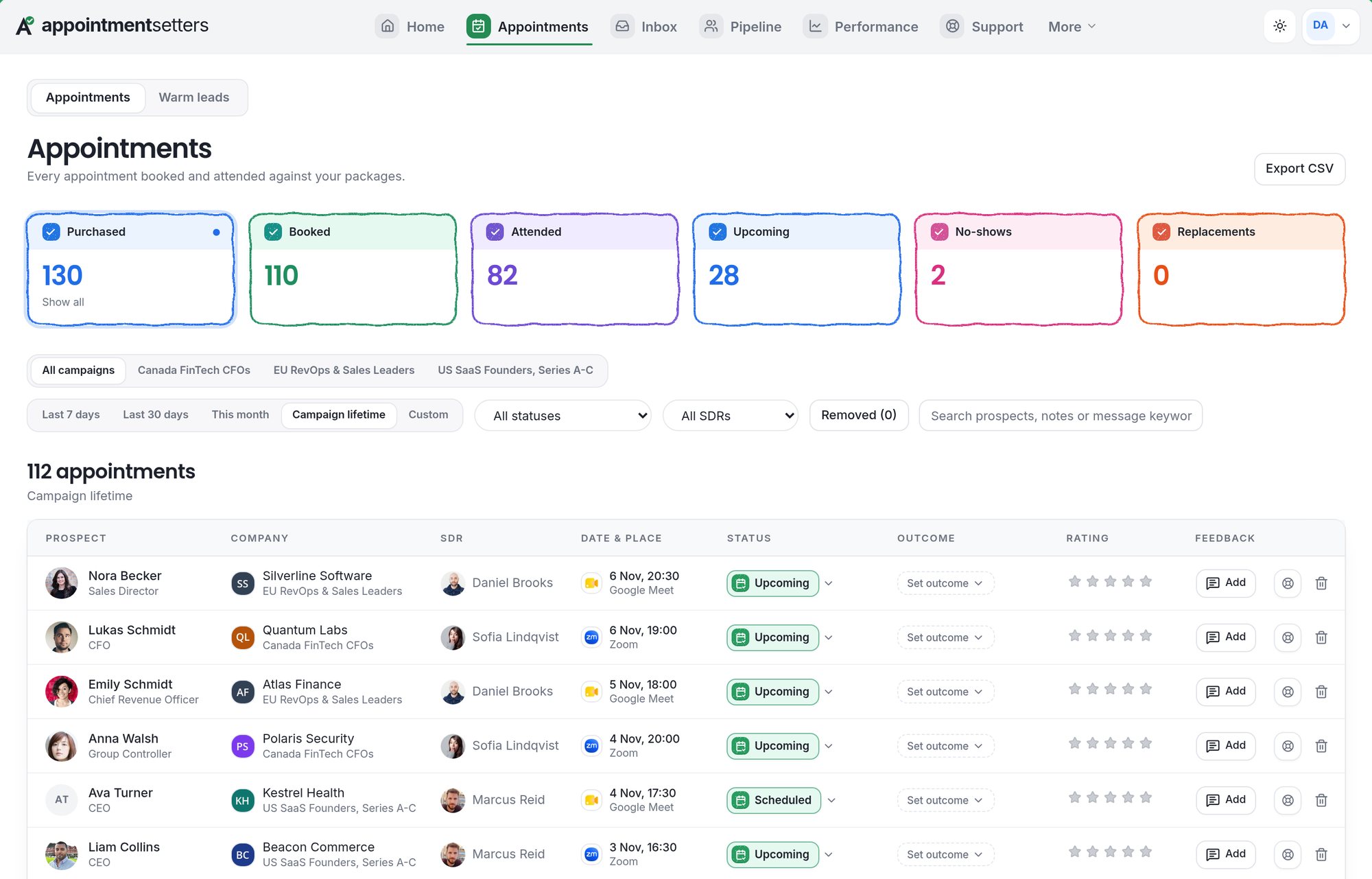
You pay for attended appointments, not activity. The Starter pilot is 10 attended appointments for $2,500. Pro is 25 for $5,625, Elite is 50 for $10,000 and Enterprise is 100 for $15,000. No-shows are replaced, and we keep working until your number is delivered. Fees are not refundable once work has started. See our page on appointment setting for IT and managed service providers for more detail.
Frequently asked questions
What is the best lead generation strategy for an MSP?
Combine referrals and partner programmes with one controllable outbound channel. LinkedIn outreach works well for MSPs because you can target owners, operations leaders and IT decision makers by company size, industry and location, and reach them when a trigger such as a new office or compliance requirement appears.
Who should an MSP target?
At companies with 10 to 50 employees, target the owner or managing director. At 50 to 250 employees, target the operations or finance director who owns the IT contract. At larger companies, target the IT director or CIO, with the CFO involved in contract decisions.
How do MSPs get clients that already have an IT provider?
Stay visible and reach them at the right time. Watch for triggers like new leadership, rapid hiring, office moves, insurance renewals and new security requirements, and offer a low risk first step such as an IT or security review rather than asking them to switch straight away.
Does this work for cybersecurity companies too?
Yes. The same approach applies to cybersecurity firms and IT consultancies: target the people who own security and compliance, lead with a specific risk or requirement, and offer a short review as the first step.
How much does MSP appointment setting cost?
With AppointmentSetters you buy attended appointments in one-time packages: 10 for $2,500, 25 for $5,625, 50 for $10,000 or 100 for $15,000. There is no monthly retainer and no-shows are replaced.
Appointment setting by region
- B2B appointment setting agency
How our agency model works and what you get in each package.
- B2B appointment setting in the USA
US-focused targeting, time zones and compliance.
- B2B appointment setting in the UK
UK market targeting and GDPR-compliant LinkedIn outreach.
Choose your appointment package
- Starter - 10 attended appointments
$2,500 one-time, $250 per attended appointment.
- Pro - 25 attended appointments
$5,625 one-time, $225 per attended appointment.
- Elite - 50 attended appointments
$10,000 one-time, $200 per attended appointment.